

When government agencies use software to create, manage, or publish regulations, those systems are subject to the Americans with Disabilities Act of 1990 (ADA).
Regulatory software falls under ADA Title II as a government service, and accessibility obligations extend to every part of the regulatory lifecycle. This includes how rules are drafted, published, and how the public accesses them.
To know if your regulatory software is ADA compliant, start by asking yourself this simple question: “Can people with disabilities participate independently in regulatory processes?”
In reality, this means:
- Someone using a screen reader should be able to discover a proposed rule, read the full text, and submit a comment without calling for help.
- Someone navigating by keyboard alone should be able to complete a licensing application from start to finish.
These obligations also apply to internal workflows when they affect public access or outcomes.
If your agency's regulation management system creates inaccessible PDFs or generates public notices that screen readers cannot interpret, that’s an ADA compliance issue.
In this article, you’ll understand how ADA compliance applies to regulatory software, why it matters, and how it must be governed.
Why ADA Title II squarely covers regulatory software
TL;DR Digital regulation systems fall within ADA Title II obligations. This is settled law, and agencies are expected to comply accordingly.
Regulatory activity as a government service
Rulemaking, licensing, and enforcement are core public functions that determine who can operate a business, what standards must be met, and how laws are implemented.When agencies moved these functions from paper filing systems to digital platforms, they did not leave ADA obligations behind.Digital systems are now the primary way agencies deliver these services.
- Members of the public do not mail comments to a docket anymore; they submit them through online portals.
- Applicants do not fill out paper forms at a counter; they complete multi-step workflows in licensing systems.
The shift to digital delivery means accessibility is no longer about ramps and door widths. It is about whether the software itself allows equal participation.
DOJ and court interpretation
ADA Title II covers digital delivery of government programs. The Department of Justice has consistently applied Title II to websites, portals, and digital services that state and local governments use to provide access to programs and activities.
Regulatory portals are treated the same as other public-facing services, whether that is paying a parking ticket, applying for benefits, or submitting public comment on a proposed rule.
The accessibility standard applied to regulatory systems
WCAG 2.1 Level AA as the enforcement benchmark
The Web Content Accessibility Guidelines, specifically WCAG 2.1 Level AA, serve as the standard in DOJ settlements involving government systems.
These guidelines are applied to portals, forms, workflows, documents, and multimedia. When the DOJ investigates accessibility complaints or negotiates consent decrees, WCAG 2.1 AA is the benchmark agencies are held to.
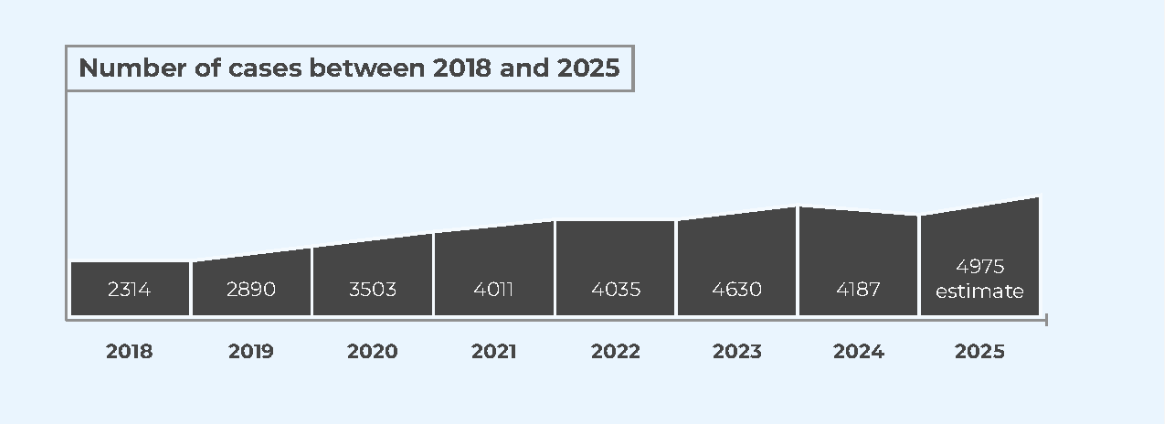
It’s important to note that by mid-2025, plaintiffs had filed a total of 2,019 digital accessibility lawsuits. That number has increased steadily year over year since 2018.
What WCAG looks like in regulatory software
WCAG measures user experience and outcomes, not just code. In practice, this means
- Screen reader compatibility across workflows, so users can navigate from rule discovery to comment submission without hitting dead ends.
- Keyboard access through multi-step processes. This allows people who cannot use a mouse to complete a licensing application.
- Accessible validation and error messaging, so people using assistive technology know exactly what went wrong and how to fix it.
In essence, passing an automated scan does not mean your system is compliant. Compliance is about whether real people with disabilities can complete real tasks independently.
What ADA compliance means in a regulatory context
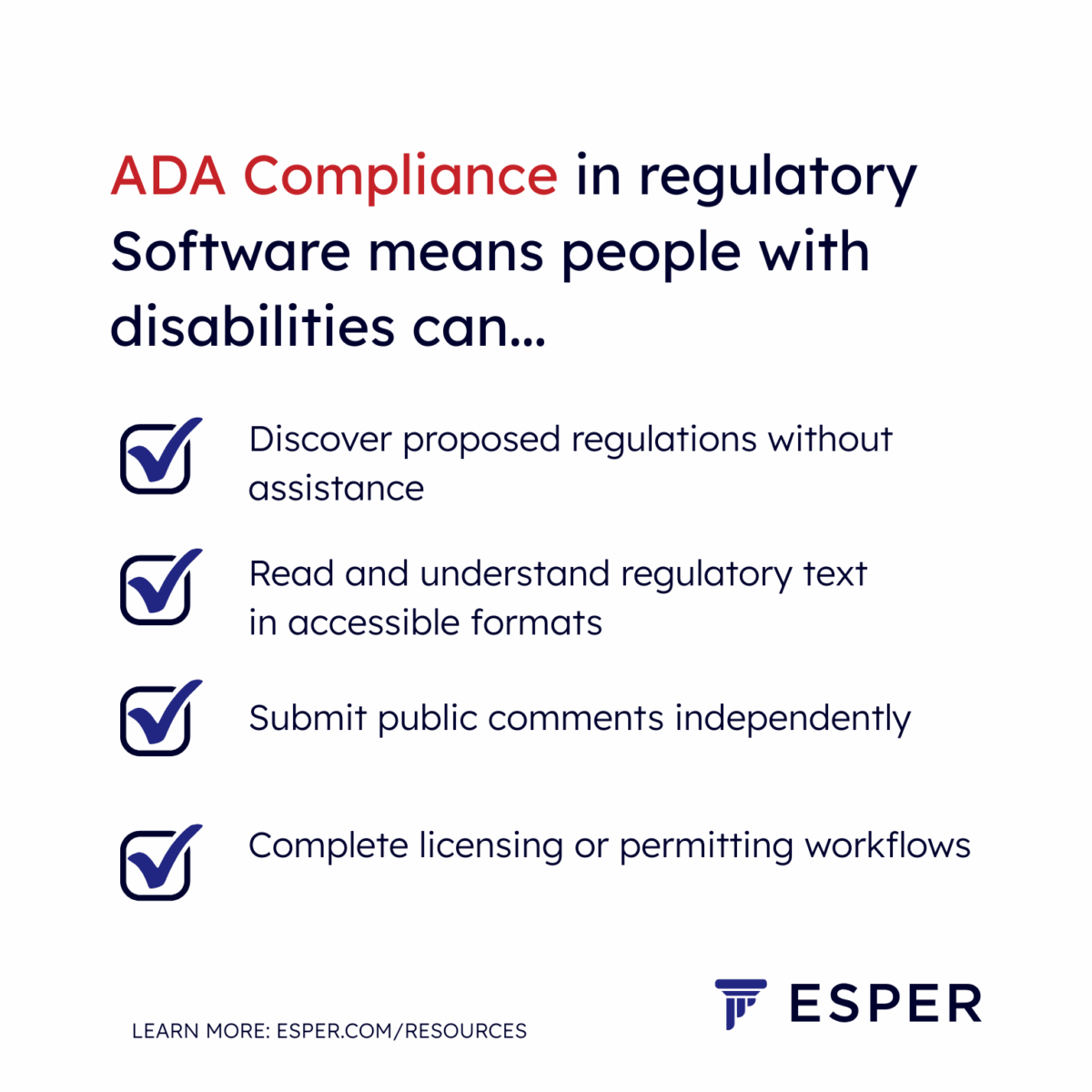
ADA compliance in regulatory software means individuals with disabilities can discover proposed regulations without assistance, browsing rulemaking dockets the same way anyone else would.
It means they can read and understand regulatory text in accessible formats, not PDFs that screen readers cannot parse. It means they can submit public comments independently, without needing to call an agency hotline or request alternative formats.
Compliance also means people can complete licensing or permitting workflows from start to finish, access hearing materials and recordings with captions or transcripts, and receive notices and updates without barriers that force them to rely on others.
With ADA, people living with disabilities have the same access to governance as people living without.
When someone cannot independently engage with a proposed rule or complete a permit application, they are excluded from processes that affect their rights, their business, and their community. That is what ADA compliance addresses in regulatory systems.
Regulatory software components that must be accessible
ADA obligations apply to the full range of systems agencies use to administer regulations. This includes
- Regulation and code management platforms where rules are drafted and organized
- Public notice and publication systems that announce proposed changes
- Public comment and rulemaking portals where stakeholders submit feedback
- Licensing and permitting applications
- Digital forms with validations and workflows
- PDFs and notices that communicate requirements
- Virtual hearings along with their recordings and transcripts
Each of these components is part of how the government delivers regulatory services. If any part of the process is inaccessible, people with disabilities are blocked from participating fully. Physical accessibility, such as building access and in-person accommodations, is separate and not addressed here. This article focuses on digital systems.
Where regulatory software commonly fails ADA compliance
Accessibility failures in regulatory systems follow predictable patterns. These are not hypothetical risks; they are issues agencies encounter repeatedly:
- Regulatory text published only as inaccessible PDFs that screen readers cannot navigate or interpret
- Complex, multi-step forms without proper labels or error cues, leaving users guessing what information is required
- Keyboard traps in comment or licensing workflows that prevent users from moving forward or backward
- Screen readers unable to interpret dynamic content, such as real-time validation or conditional form fields
- Missing captions or transcripts for hearings, excluding people who are deaf or hard of hearing
- Accessibility regressions after rule updates or software changes, breaking features that previously worked
- Staff publishing inaccessible amendments or notices because content management systems lack built-in accessibility checks
These failures result in complaints, investigations, and barriers that agencies must remediate under pressure.
What ADA compliance does not look like in regulatory systems
Some approaches to accessibility do not satisfy ADA obligations, even when well-intentioned. These include:
- Offering phone or email alternatives to public participation instead of making the digital system itself accessible
- Posting "accessible upon request" notices that shift the burden onto people with disabilities
- Relying solely on vendor VPATs (Voluntary Product Accessibility Templates) as proof of compliance
- Treating accessibility as a pre-launch checklist rather than an ongoing requirement

Three points must be clear.
- Vendors do not absorb legal liability; under ADA Title II, the agency remains responsible regardless of contractual language.
- VPATs do not establish compliance; they are vendor self-assessments, not independent audits or guarantees.
- Alternative access channels cannot serve as the default; requiring users to call or email for access others receive digitally does not meet the standard of equal access.
ADA compliance means the primary system works for everyone. Workarounds are not substitutes.
Governance and ownership in regulatory environments
A shared accountability model
ADA compliance in regulatory software requires coordination across multiple functions. Responsibility should be distributed as follows:
- Legal: ADA interpretation, enforcement risk assessment, and consent decree exposure
- CIO or IT: Platform selection, configuration, testing, and lifecycle management
- Regulatory programs: Content accuracy, notices, and workflow design
- ADA coordinator: Standards, oversight, and issue escalation
No single office can manage accessibility alone. Legal understands the obligations, IT controls the systems, program staff create the content, and the ADA coordinator ensures consistency. When these roles are unclear or siloed, compliance gaps emerge.
Accessibility as a standing regulatory control
Accessibility should function like other regulatory controls agencies already follow. It’s comparable to records retention and transparency laws — something that applies every time a rule is published, or a form is updated.This means accessibility must be embedded in change management and publishing workflows, not treated as a separate initiative. When a program office updates a regulation or launches a new licensing portal, accessibility checks should be part of the standard process.
Procurement implications for regulatory software
Accessibility obligations begin at procurement. Agencies cannot outsource compliance to vendors, which means solicitations and contracts must be explicit about requirements:
- Accessibility requirements must be explicit in solicitations, including specific WCAG 2.1 Level AA conformance
- Accessibility testing must include real regulatory workflows, not just homepage navigation or generic forms
- Agencies remain responsible after go-live, regardless of vendor representations or warranties
- Accessibility must be maintained through updates and amendments, not just at initial launch
Vendors may claim their software is accessible or provide VPATs as evidence. These are useful starting points, but do not transfer legal responsibility. ADA compliance is a governance responsibility, not a vendor feature. The agency must verify that the system works for people with disabilities in the specific regulatory contexts where it will be used.
Why ADA compliance matters in regulation and rulemaking
The importance of ADA compliance in regulation and rulemaking can be divided into three:
Civil rights
Equal access to lawmaking and administrative processes is foundational. When regulatory systems exclude people with disabilities, they are shut out of decisions that shape their lives and livelihoods. Accessibility is not a courtesy; it’s a legal and moral requirement.
Legal and enforcement risk
Investigations tied to inaccessible notices, comments, or hearings create significant exposure. DOJ complaints, consent decrees, and legal challenges disrupt operations and require costly remediation. These risks increase when agencies cannot demonstrate that accessibility was considered in system design and governance.
Operational governance
Accessible systems mean fewer emergency remediations, defensible audits and reviews, and predictable regulatory timelines. When accessibility is embedded in workflows, agencies avoid the disruption of retrofitting systems under pressure or delaying rulemakings to fix compliance issues.
Conclusion: What agencies responsible for regulatory software should do next
Esper helps government agencies centralize and govern policy and regulatory content in an ADA-compliant way. While Esper does not remediate entire websites, it ensures that the highest-risk, most visible content — policies and regulations — meets accessibility standards by design and remains compliant over time. Esper serves as the foundation layer of an agency’s ADA compliance strategy, reducing risk and preventing future accessibility regressions.
ADA compliance in regulatory software isn’t optional, and it isn’t solved once. Compliance requires governance, coordination, and sustained attention across the lifecycle of every system that delivers regulatory services to the public.
If your agency is responsible for rulemaking, licensing, or regulatory publication systems, request a demo briefing to see how modern regulatory software can support ADA obligations by design.