Four Hidden Costs of Outdated HR Policies—And the Playbook to Fix Them
When Salt Lake County auditors discovered that **12 % of all county policies were outdated—some naming departments that no longer exist—**it wasn’t just an administrative footnote. Out‑of‑date rules translate into compliance gaps, employee frustration, and public‑trust headaches.
The Hidden Costs
| Cost | Real‑world evidence |
| Regulatory & legal risk | Connecticut’s legislature filed required FMLA forms up to 77 days late—a lapse auditors flagged for the third time. |
| Financial exposure | One CT public‑safety agency paid $141,000 in excess overtime because 15‑year‑old policies didn’t match its new payroll system. |
| Inefficiency | A California city finance manual last edited in the 1990s spawned conflicting procedures and wasted staff hours. |
| Reputation damage | When obsolete policies surface in court or the press, public confidence tanks and leaders face scrutiny. |
Four Modernization Moves
- Put every policy in a single digital library. Sacramento and Mississippi DCPS cut the “where’s the latest copy?” hunt to seconds with a cloud repository.
- Adopt a scheduled review cycle. Tie annual or biennial reviews to the legislative calendar so new laws roll in on day one—not after an audit.
- Automate workflows & attestation. Esper routes drafts to legal, tracks edits, and logs employee e‑signatures—eliminating version chaos and providing a defensible audit trail.esper.com
- Engage stakeholders early. Agencies that frame modernization as a mission‑critical service improvement secure buy‑in from unions, counsel, and field staff alike.
Success Snapshot
The Arkansas Game & Fish Commission adopted Esper to transform regulatory operations, giving staff and citizens timely, accurate access to policies while cutting manual steps.esper.com
Self‑Assessment: Are You Red, Yellow, or Green?
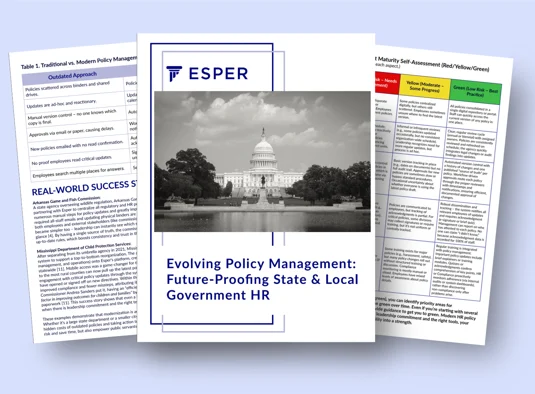
The e‑book includes a quick diagnostic scoring your repository, review cadence, version control, distribution, and training practices. Mark your weak spots and prioritize the first “green” win.
Conclusion & Next Step
Modern HR policy management isn’t a luxury—it’s a risk‑reduction imperative. Agencies that centralize, automate, and track policies see fewer audit findings, faster updates, and a measurable boost in employee trust.
Ready to benchmark your agency? Download the full e‑book “Evolving Policy Management: Future‑Proofing State & Local Government HR” for the complete roadmap and templates.